
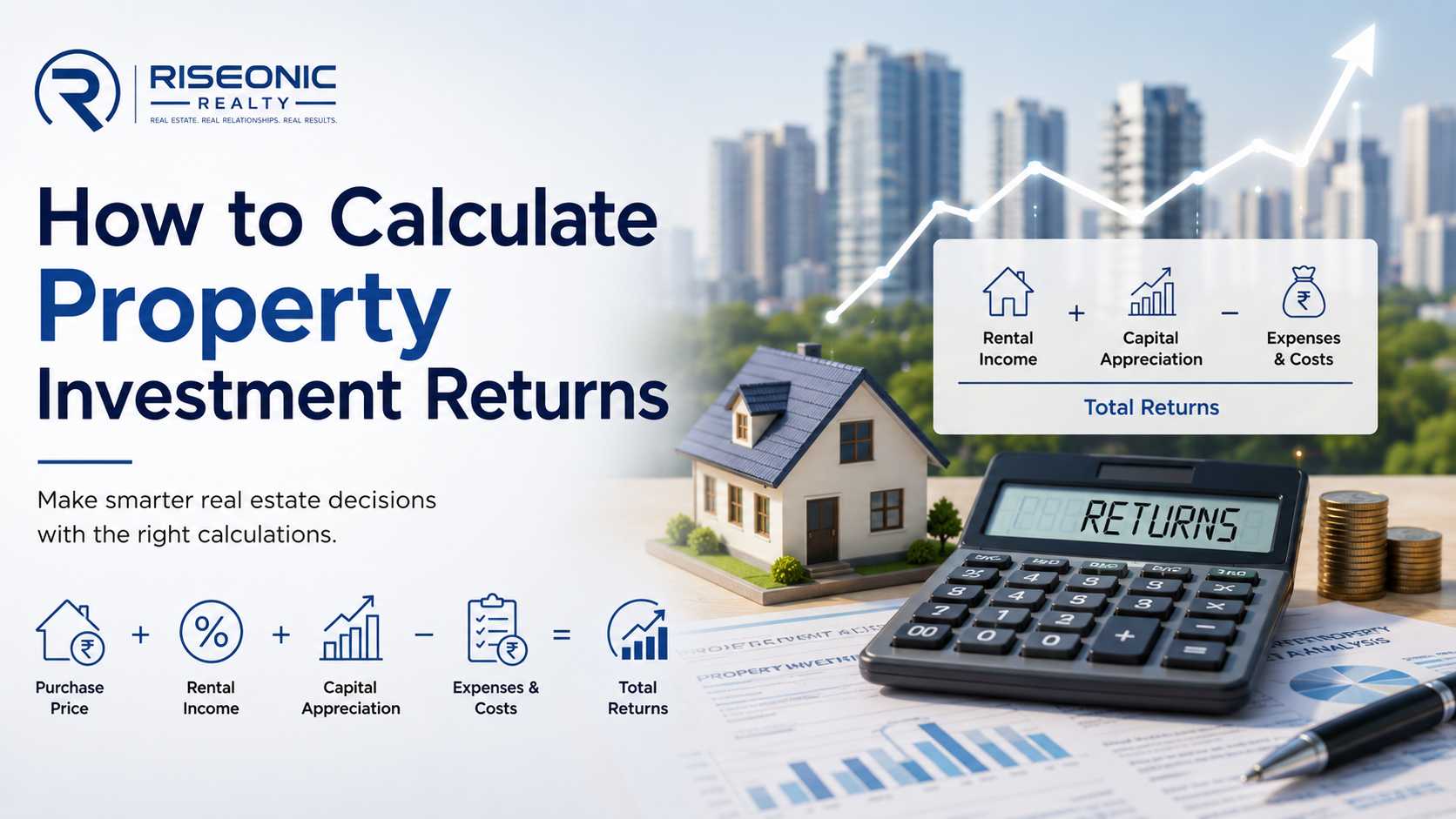
How to Calculate Property Investment Returns

Buying a property is often seen as a long-term investment. But before putting your money into a flat, villa, plot, or commercial property, one important question should always come to mind: How much can I actually earn from this investment?
Understanding investment returns can help you answer that question. Instead of looking only at the property's purchase price or expecting its value to increase, you should consider rental income, property appreciation, expenses, taxes, and the amount you initially invested.
The good news is that you don't need to be a financial expert to understand these calculations. With a few simple concepts, you can get a clearer picture of whether a property is likely to be a good investment.
At Riseonic Realty, we believe that informed decisions are the foundation of successful property investment. Let's understand the basics of calculating property investment returns simply.
What Are Investment Returns?
Investment returns refer to the money you gain from an investment compared with the amount you originally invested.
In real estate, your return can come from different sources. The most common are rental income and the increase in the property's market value over time.
For example, imagine you purchase a property for ₹50 lakh. After a few years, its market value increased to ₹65 lakh. If you have also earned rental income during that period, your overall return comes from both the property's appreciation and the rental income.
This is why looking at only the purchase price and future selling price doesn't give you the complete picture.
Start With the Total Property Cost
Investment Returns Begin With the Right Cost
Before calculating investment returns, first understand how much you are actually spending on the property.
The purchase price is only one part of the total cost. Depending on the property and transaction, you may also have expenses such as registration charges, stamp duty, brokerage, loan-related costs, interiors, maintenance, and other purchase expenses.
For example, if a property costs ₹50 lakh but your total investment becomes ₹55 lakh after additional expenses, your calculations should ideally start with ₹55 lakh rather than ₹50 lakh.
This gives you a more realistic understanding of your Property ROI.
Calculate Rental Yield
Rental Yield Is an Important Part of Investment Returns
If you plan to rent out your property, rental income can become an important source of regular returns.
Rental yield measures how much rental income a property generates compared with its value.
A simple formula is:
Rental Yield = (Annual Rental Income ÷ Property Value) × 100
For example, suppose you purchase a property for ₹60 lakh and receive ₹25,000 per month in rent.
Your annual rental income would be:
₹25,000 × 12 = ₹3,00,000
Your approximate rental yield would therefore be:
₹3,00,000 ÷ ₹60,00,000 × 100 = 5%
This means the property generates an approximate gross rental yield of 5% per year.
However, remember that this is a basic calculation. Maintenance, vacancy periods, taxes, repairs, and other expenses can reduce your actual rental income.
Understand Capital Appreciation
Capital Appreciation Can Increase Investment Returns
Another major component of investment returns is capital appreciation.
Capital appreciation means the increase in the value of your property over time.
For example, if you purchase a property for ₹50 lakh and sell it later for ₹70 lakh, your capital appreciation is ₹20 lakh before considering transaction costs and taxes.
You can calculate the basic appreciation percentage using:
Capital Appreciation = ((Current Value − Purchase Value) ÷ Purchase Value) × 100
In this example:
₹70 lakh − ₹50 lakh = ₹20 lakh
₹20 lakh ÷ ₹50 lakh × 100 = 40%
So, the property has appreciated by approximately 40% over the holding period.
Of course, property prices do not always increase at the same rate. Location, infrastructure, demand, economic conditions, and the overall property market can influence future appreciation.
Calculate Property ROI
Property ROI Gives You a Bigger Picture
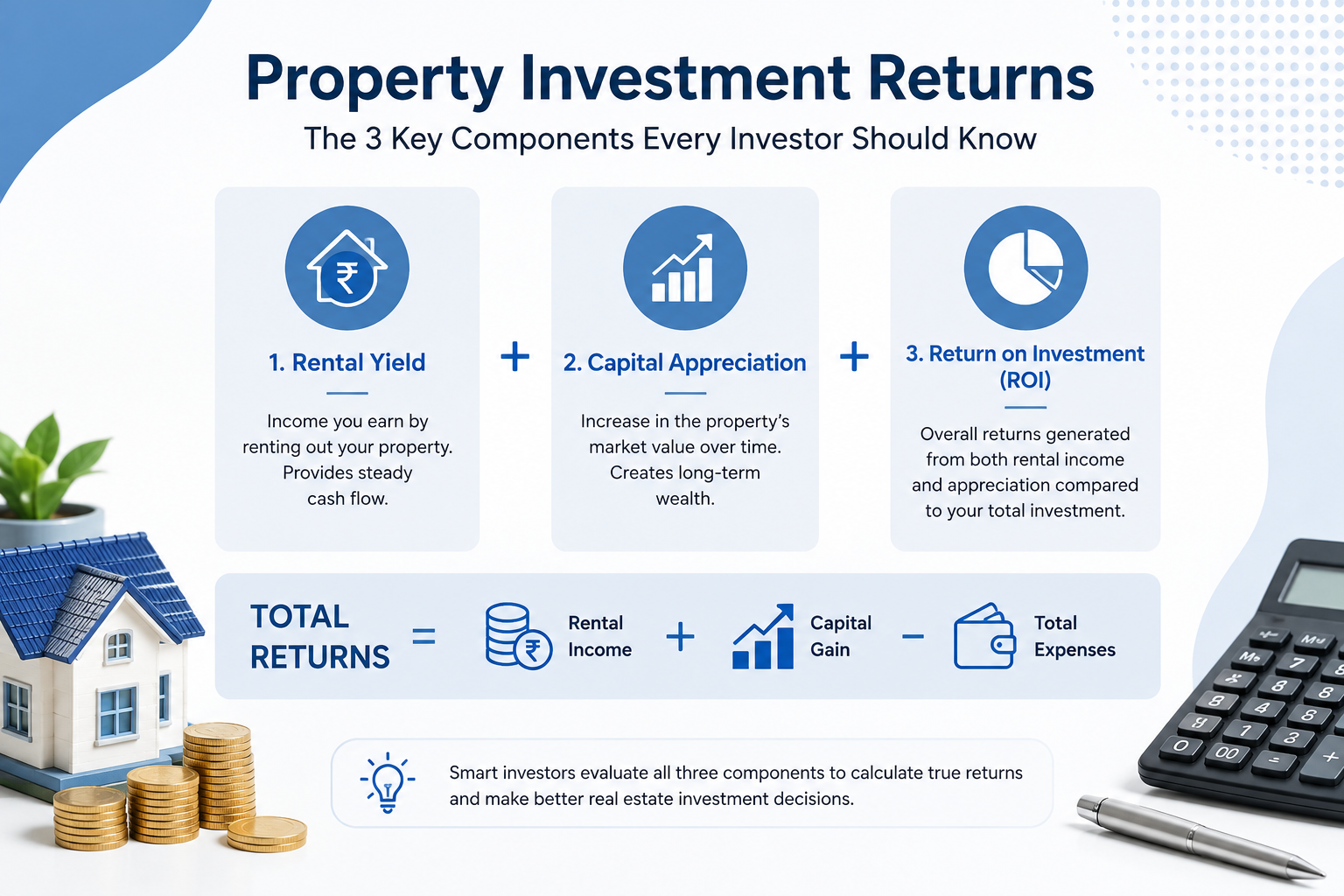
While rental yield and capital appreciation are useful individually, Property ROI helps you look at the overall performance of your investment.
A simplified ROI formula is:
ROI = (Total Gain ÷ Total Investment) × 100
Suppose your total investment in a property is ₹55 lakh. After several years, you sell it for ₹70 lakh and have earned ₹9 lakh in rental income.
Your total gain before applicable selling costs, taxes, and other adjustments would be:
₹15 lakh capital gain + ₹9 lakh rental income = ₹24 lakh
Your approximate ROI would then be:
₹24 lakh ÷ ₹55 lakh × 100 = 43.6%
This is a simplified example, but it shows why investors should consider both property appreciation and rental income instead of focusing on just one number.
Consider the Holding Period
Investment Returns Should Be Measured Over Time
A property generating a 40% return over two years is very different from a property generating the same 40% return over ten years.
The holding period matters when evaluating investment returns.
For a more meaningful comparison, investors can look at annualized returns, which help understand how the investment performed on average each year.
This becomes particularly useful when comparing real estate with other investment opportunities.
Instead of asking only, "How much did my property increase in value?" ask, "How much did it grow each year after considering my costs?"
Location Can Affect Investment Returns
Choose Locations With Growth Potential
Location is one of the biggest factors influencing investment returns.
A property located near major employment hubs, transport networks, schools, hospitals, shopping areas, and upcoming infrastructure may have stronger demand over time.
For investors, it's important to look beyond what the neighborhood looks like today. Upcoming roads, metro connectivity, commercial developments, and new business hubs can influence future demand.
However, future development should always be researched carefully rather than treated as a guaranteed increase in property prices.
Don't Ignore Property Expenses
Expenses Can Reduce Investment Returns
A property may look profitable on paper until you calculate the actual expenses.
Maintenance charges, property taxes, repairs, insurance, brokerage, vacancy periods, loan interest, and selling costs can all affect your final return.
For example, if your property generates ₹3 lakh in annual rent but you spend ₹60,000 on maintenance and other costs, your actual income is lower than the initial rental figure suggests.
This is why serious investors should calculate net returns, not just gross returns.
Compare Properties Before Investing
Compare Investment Returns Before Buying
Don't evaluate a property in isolation.
If you're considering multiple properties, compare their purchase prices, expected rent, location, maintenance costs, future development, and potential appreciation.
One property may have a higher rental yield, while another may offer stronger long-term appreciation potential. The better choice depends on your investment objective, budget, risk tolerance, and holding period.
Taking time to compare different opportunities can help you avoid making an investment decision based purely on emotion.
Think Beyond Short-Term Investment Returns
Real estate is generally considered a long-term asset. Trying to predict exactly how much a property will be worth in a few months or even a year can be difficult.
Instead, consider the bigger picture.
Ask yourself whether the location has sustainable demand, whether the property meets the needs of potential tenants or future buyers, and whether you can comfortably hold the investment for the required period.
A property that performs steadily over many years may be more valuable to an investor than one that promises quick but uncertain gains.
Conclusion on Investment Returns
Calculating investment returns doesn't have to be complicated. Start with the total amount invested, estimate rental income, calculate potential capital appreciation, account for expenses, and consider how long you plan to hold the property.
Most importantly, don't make a property investment decision based on expected returns alone. Location, property quality, legal documentation, market demand, financing costs, and your own financial goals all matter.
If you're exploring property investment opportunities, Riseonic Realty can help you discover properties and make more informed decisions based on your requirements.
For additional guidance, you can also read our First-Time Home Buyers guide, which covers important considerations before purchasing a property: Top 10 Tips for First-Time Home Buyers
For official information related to financial and banking regulations in India, investors can also refer to the Reserve Bank of India.
A good real estate investment isn't simply about buying a property and hoping its value increases. It's about understanding the numbers, researching the location, planning for the long term, and making a decision that fits your financial goals.